
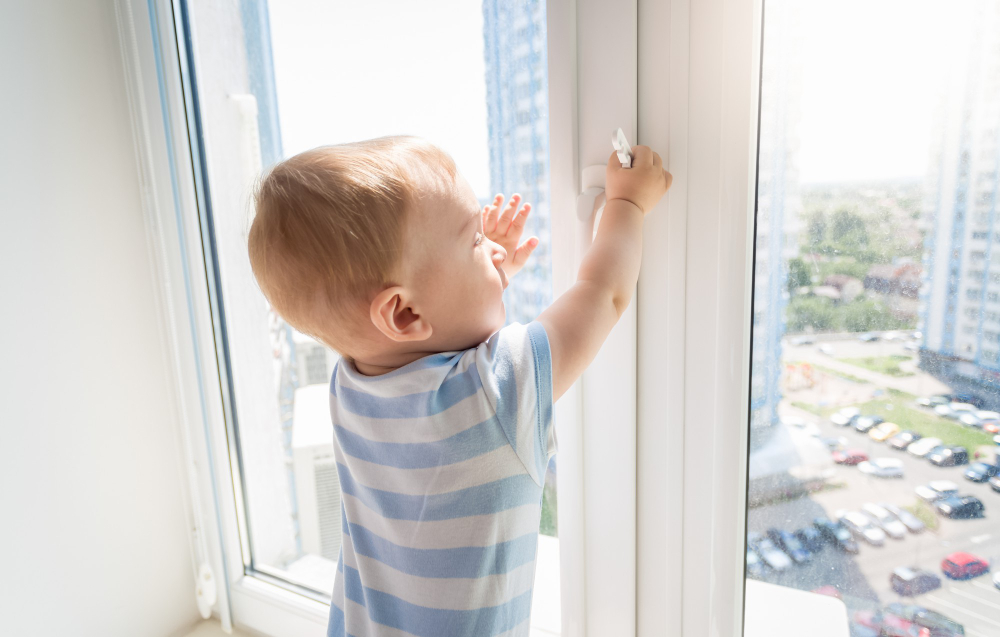
Upstairs windows are an often-overlooked safety risk in family homes. When choosing coverings or screens, most of us think about keeping insects out, privacy and décor. For households with babies, toddlers or young children, though, a window above ground level needs more careful thought. It’s worth knowing from the start that a standard insect screen is not designed to stop a child from falling.
The right solution depends on how each room is used. A bedroom window might need to stay open overnight, while a playroom window could be reachable from a bed or toy box. Window style matters too whereby a tilt-and-turn window calls for a different approach from a sash window. This post covers how to assess each window and what to consider before choosing protection, without losing natural light, airflow or appearance.
Start by Looking at Your Home From a Child’s Perspective
Young children do not recognise the dangers of heights. A chair, sofa, bed or toy box beside a window can become a climbing aid, allowing a child to reach a handle or lean out of an opening.
Walk through your upstairs rooms and check the position of beds, desks and storage furniture, and note any windows with low internal sills. Outward-opening windows deserve a look too, as they can tempt a child to reach or lean through the gap. Pay particular attention to rooms where children spend time unsupervised, even briefly. Many incidents happen in short gaps in supervision, such as while you answer the door or take a phone call.
The surface below matters as well. A fall onto a patio, driveway or tiles is likely to cause more serious injury than a fall onto soft ground, but neither should be treated as safe. Children’s abilities also change quickly. A baby who cannot yet crawl can be climbing furniture within months, so revisit your assessment as your child grows.
Moving furniture away from windows is sensible, but it should complement physical safety measures rather than replace them.
Know the Benchmark for Fall Protection
Children aged one to five are most at risk of falling from windows and balconies. Under the National Construction Code, openable bedroom windows with a floor level two metres or more above the ground outside generally need protection. The commonly applied requirement is that the opening must not allow a 125mm sphere to pass through and that the barrier must withstand 250N of force. These rules, often called the Kids Don’t Fly requirements, were introduced for new residential builds in 2013.
The exact provisions depend on the building class and when the home was approved. Older homes may not be legally required to comply, yet the fall risk is identical, so many owners choose to meet the same benchmark. A building certifier or licensed installer can confirm what applies to your property.
Fly Screen, Restrictor or Security/Barrier Screens: What Each One Does
- Fly and insect screens use light mesh in a slim frame to keep insects out. They are not designed to carry a load, and a child leaning on one can push it out of its frame.
- Window restrictors limit how far a sash or casement opens. They must be fitted so the gap stays within the benchmark and a child cannot release them. Because the opening is small, airflow is reduced.
- Barrier screens are fixed to the window frame or reveal and cover the entire opening, so the window can open fully behind them. Basix, Xceed and Secure View are the ranges we install to meet the Kids Don’t Fly requirements, so windows can stay open for ventilation without restrictors limiting airflow.
Don’t Judge a Product by Its Appearance
A solid look or a metal frame does not mean a product is safe. Performance depends on the complete assembly, including the mesh or panel, frame, fixings and the surface it is fixed to. A strong panel in a weak mounting will not perform as intended. Likewise, a standard lock or improvised restriction should not be assumed to provide compliant protection, and even products sold as security screens need to be assessed against the purpose they are being installed for.
Ask about the product’s testing, the applicable Australian Standards and its suitability for your window and mounting surface. We’re happy to talk you through the details for your home. Where compliance is uncertain, seek advice from a suitably qualified professional before deciding.
Safe Doesn’t Have to Mean Stuffy
A safety measure works best when it fits your routine. Warm, humid nights can make upstairs bedrooms uncomfortable if windows can’t be opened, so choose a solution that protects without unnecessarily restricting airflow. A suitable security screen can do this and can also improve resistance to unauthorised entry, with different designs offering different levels of visibility and privacy.
Maintenance matters too. Salt air, humidity and regular use take a toll on screens and fittings, so inspect them periodically for loose fasteners, damaged mesh and corrosion, and have anything detached or damaged assessed promptly. Our guide to the signs it is time to upgrade your security screens lists what to look for.
Before deciding, consider how often the window is opened, whether it needs cleaning from inside, whether a screen will interfere with existing hardware and how the room could be exited in an emergency.
Make Window Safety Part of Your Home Improvements
Upstairs window safety is worth revisiting whenever you renovate a bedroom, rearrange furniture or prepare a home for a growing family. If you’re considering an upgrade, our team provides security screen installation across the Gold Coast and can help you compare options and understand installation requirements. The priority is a solution that suits the window, meets the relevant safety requirements and fits the way your household lives.